
Advanced Filament Types: ABS / ASA / PC / Fiber Infused Filament
ABS
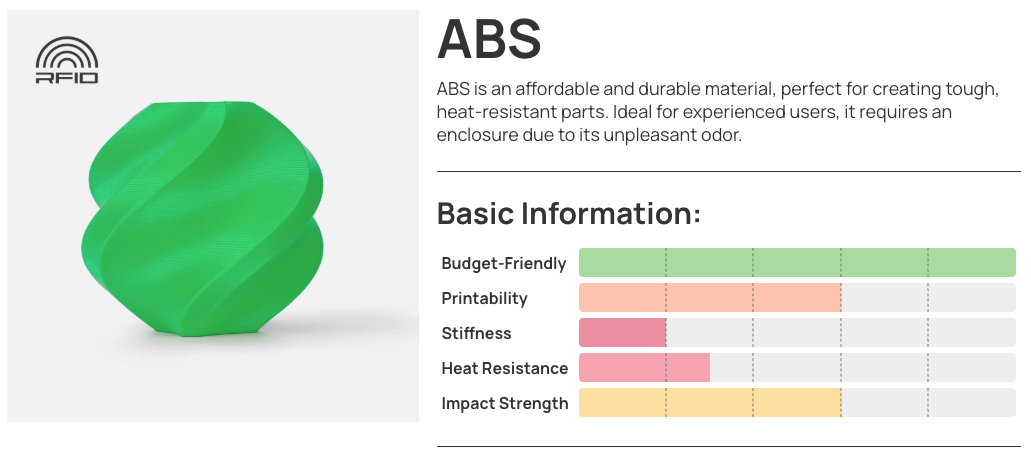
ABS (Acrylonitrile Butadiene Styrene) is a durable and impact-resistant thermoplastic widely used in 3D printing for functional parts, mechanical components, and high-temperature applications. It offers excellent strength and flexibility, making it suitable for items that need to withstand stress, such as enclosures, tools, and automotive parts. ABS prints at higher temperatures (around 230-250°C) and requires a heated bed (90-110°C) to minimize warping and ensure strong layer adhesion.
One of the key advantages of ABS is its higher heat resistance compared to PLA, making it less likely to soften or deform under warm conditions. However, it is more prone to warping and shrinkage, especially when printing large parts without an enclosure. To improve print quality, ABS is best printed in a temperature-controlled environment or inside a fully enclosed printer.
Unlike PLA, ABS produces noticeable fumes during printing, which can be irritating if inhaled in poorly ventilated areas. Printing in a well-ventilated space or using an air filtration system is recommended.
ABS is also more hygroscopic than PLA, meaning it absorbs moisture from the air more quickly. This can negatively affect print quality, leading to issues like bubbling or weak layer adhesion. To maintain optimal performance, ABS filament should be stored in an airtight container with desiccants when not in use.
Learn more about ABS in the Bambu Lab Filament Guide
ASA
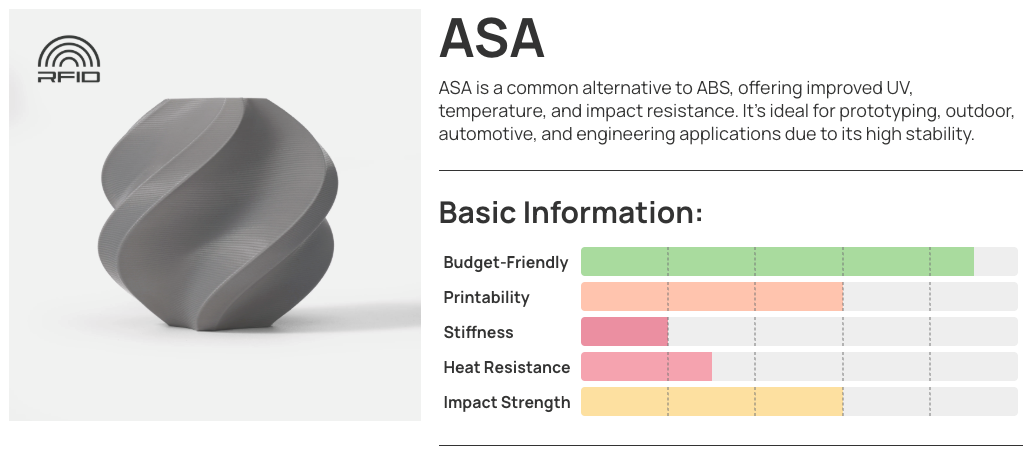
ASA (Acrylonitrile Styrene Acrylate) is a high-performance thermoplastic similar to ABS but with improved weather resistance, UV stability, and chemical resistance. It is commonly used for outdoor applications such as automotive parts, garden tools, and functional prototypes that need to withstand prolonged exposure to sunlight and harsh environments. ASA prints at high temperatures, typically around 240-260°C, with a heated bed set to 90-110°C to prevent warping.
Compared to ABS, ASA offers better UV and weather resistance, meaning it won’t become brittle or yellow when exposed to sunlight over time. This makes it a superior choice for outdoor parts where ABS might degrade more quickly. Additionally, ASA has slightly better chemical resistance, making it more durable in industrial and automotive settings.
However, like ABS, ASA is prone to warping and benefits from being printed in an enclosed, temperature-controlled environment. It also emits noticeable fumes during printing, so proper ventilation or an air filtration system is recommended.
ASA is also hygroscopic, meaning it absorbs moisture from the air, which can negatively impact print quality by causing bubbling or weak layer adhesion. To ensure the best results, ASA should be stored in an airtight container with desiccants when not in use.
Learn more about ASA in the Bambu Lab Filament Guide
PC (Polycarbonate)
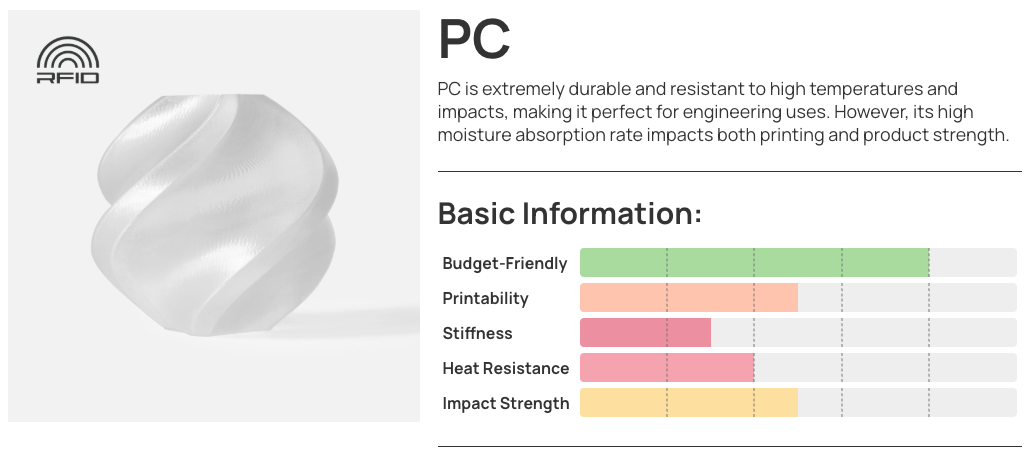
PC (Polycarbonate) is a high-strength, heat-resistant thermoplastic known for its exceptional durability, impact resistance, and thermal stability. It is commonly used in engineering applications, functional prototypes, automotive components, and protective gear where strength and heat resistance are essential. PC prints at very high temperatures, typically 250-280°C, with a heated bed set to 100-120°C to prevent warping and ensure proper adhesion.
Compared to ABS and ASA, PC offers superior mechanical strength and heat resistance, allowing it to withstand temperatures up to 110-150°C before softening. This makes it an excellent choice for parts exposed to high-stress environments, mechanical loads, or elevated temperatures where ABS or ASA would fail. However, PC is more brittle than ABS and may be prone to cracking under excessive stress, especially in thin-walled prints.
Printing PC can be challenging due to its high tendency to warp and shrink. It requires an enclosed and heated chamber to maintain a stable temperature and prevent layer separation. Additionally, PC adheres best to specialized build surfaces or adhesives, as it can detach from standard print beds.
Like ABS and ASA, PC emits noticeable fumes when printing, so proper ventilation is recommended. PC is also highly hygroscopic, meaning it readily absorbs moisture from the air, which can lead to poor print quality, bubbling, and weakened prints. To maintain optimal performance, PC filament should be stored in an airtight container with desiccants and dried before use if necessary.
Learn more about PC in the Bambu Lab Filament Guide
PA (Polyamide / Nylon)
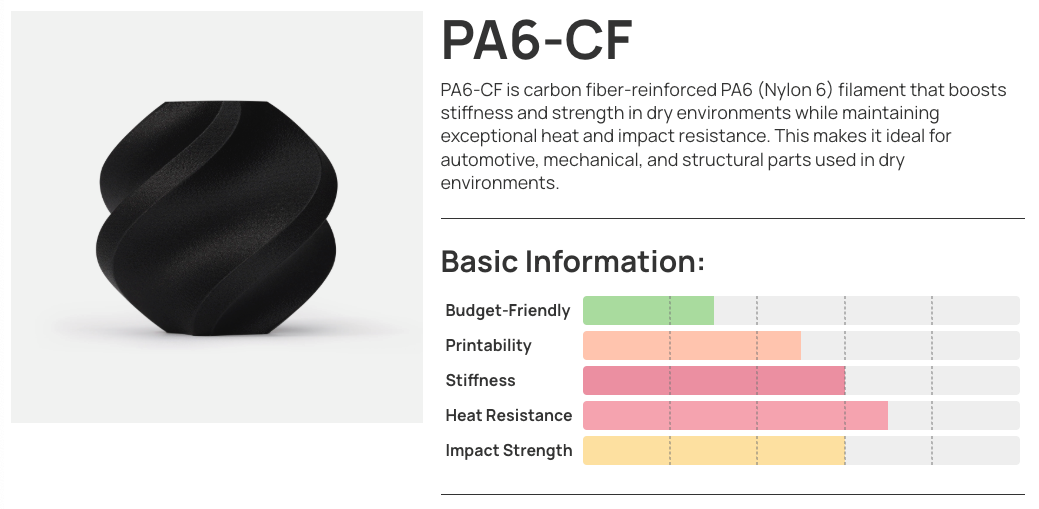
PA, commonly known as Nylon, is a strong, flexible, and wear-resistant thermoplastic widely used in engineering applications, mechanical parts, gears, hinges, and durable functional prototypes. It offers high impact resistance, excellent layer adhesion, and exceptional chemical resistance, making it a preferred material for demanding environments. PA prints at high temperatures, typically 240-270°C, with a heated bed set to 90-110°C to ensure proper adhesion and minimize warping.
Compared to ABS, ASA, and PC, Nylon is more flexible and impact-resistant, making it ideal for high-stress and load-bearing applications. However, it is also softer and more prone to wear over time, which may not be suitable for applications requiring high rigidity. Nylon also has excellent chemical resistance, outperforming ABS and PC in harsh industrial environments.
One of the biggest challenges with printing PA is its extreme tendency to absorb moisture from the air, which can severely degrade print quality, causing stringing, bubbling, and poor layer adhesion. To prevent this, PA filament must be stored in an airtight container with desiccants and dried before printing if it has absorbed moisture.
Nylon also has a higher tendency to warp, so printing in a temperature-controlled, enclosed chamber is recommended. It adheres best to specialized build surfaces, such as Garolite, PEI sheets, or glue sticks, to prevent lifting and improve first-layer adhesion. While PA doesn’t emit strong fumes like ABS or PC, proper ventilation is still advisable.
Learn more about PA in the Bambu Lab Filament Guide
Carbon Fiber-Infused Filaments
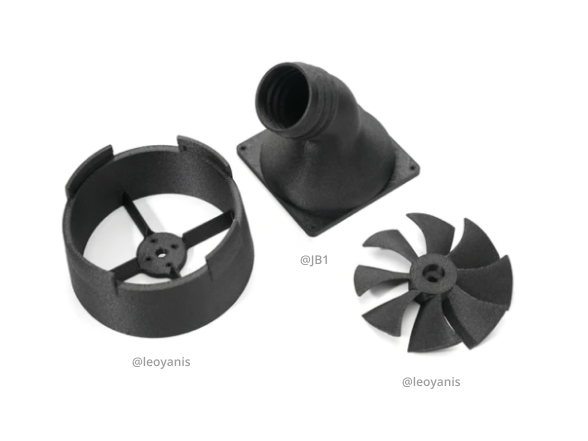
Carbon fiber-infused filaments are composite materials that combine a base thermoplastic—such as PLA, ABS, PETG, Nylon (PA), or Polycarbonate (PC)—with fine carbon fiber strands. These filaments are known for their high strength, stiffness, and lightweight properties, making them ideal for structural components, functional prototypes, aerospace applications, and automotive parts that require enhanced rigidity and durability. Printing temperatures vary depending on the base material but typically range from 220-280°C, with a heated bed set between 60-110°C, depending on the filament type.
Compared to standard versions of their base materials, carbon fiber-infused filaments offer greater stiffness, reduced warping, and lower thermal expansion, leading to better dimensional stability and improved print accuracy. However, they also tend to be more brittle, meaning parts may snap rather than bend under extreme stress.
Hardware Requirements
Due to the abrasive nature of carbon fiber particles, these filaments wear down standard brass nozzles and extruder components quickly. To print carbon fiber-infused materials reliably, a hardened steel nozzle is essential to prevent excessive wear which comes pre-installed on the X1C. A 0.6mm or larger nozzle is also recommended, as the added fibers can cause clogging in smaller diameters.
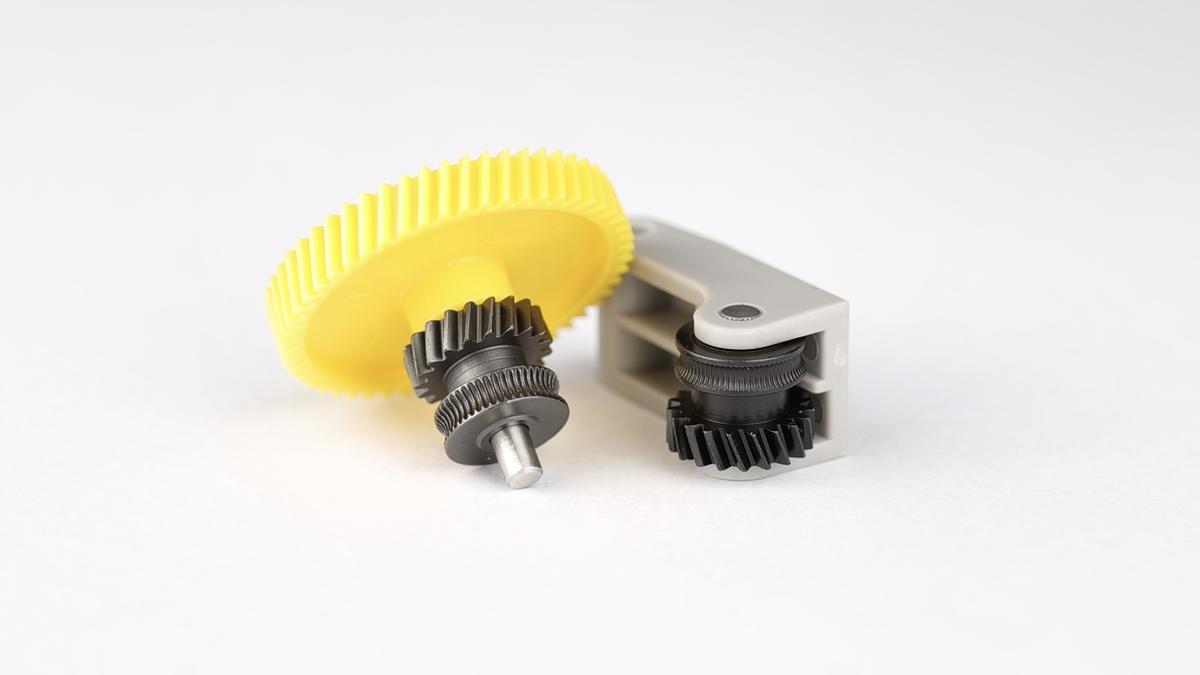
Additionally, the extruder gears are subject to increased wear when feeding abrasive filament. The X1C comes out of the box with hardened steelextruder gears that help maintain long-term reliability and consistent filament flow.
Moisture Sensitivity & Storage
Carbon fiber-infused filaments, especially those based on Nylon (PA) or Polycarbonate (PC), are highly hygroscopic and will absorb moisture from the air. This can lead to poor print quality, stringing, bubbling, and weakened parts. To ensure the best results, store these filaments in an airtight container with desiccants and dry them before printing if needed.